Self-employed invoice template (not VAT registered)
If you are self-employed and not registered for Value Added Tax (VAT), your invoice needs the details GOV.UK lists for every invoice. As a sole trader, also add your name and any business name you use. If you use a business name, add an address where legal documents can reach you.
The maker below is already set up for you. "My business is VAT-registered" is unticked, so no VAT is added, and the sole trader lines are shown.
Make your invoice with VAT switched off
Fill in your details, your customer and the work you did. Then select Download PDF. The checklist shows anything still missing. Nothing you type leaves your browser.
If you are VAT registered, use our VAT invoice maker instead.
Worked example: a freelance designer's invoice
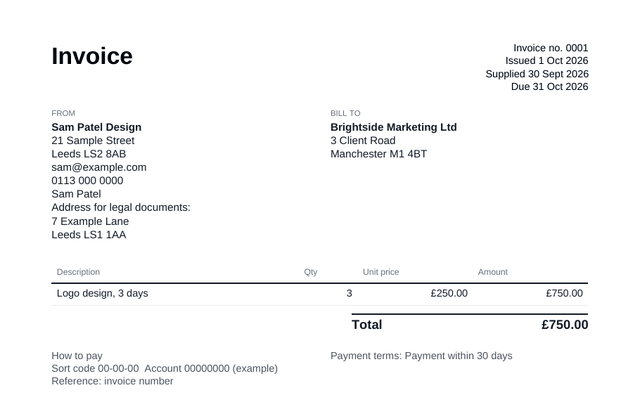
Example (the business and amounts are made up). A freelance designer is a sole trader and is not VAT registered. They worked 3 days for a client at £250 a day.
Here is what they enter in the maker above:
- Leave "My business is VAT-registered" unticked.
- Your name, business name, address for legal documents, Email and Phone: their own details.
- Customer name and Customer address: the client's details.
- Number: 0001. Date issued: 1 October 2026. Date of supply: 28 to 30 September 2026.
- Due date: 31 October 2026 (the 30 days they agreed with the client).
- Description: "Logo design, 3 days". Qty 3. Unit price £250.00.
- Select Download PDF.
What they get: an A4 PDF with no VAT added and no VAT number.
| Line | Amount |
|---|---|
| 3 days × £250.00 | £750.00 |
| VAT | none (not registered) |
| Total owed | £750.00 |
What a self-employed invoice must show
GOV.UK's list of what every invoice must include, in sole trader terms:
- a unique identification number
- your name, address and contact details
- your customer's name and address
- a clear description of what you are charging for
- the date the goods or service were provided (the supply date)
- the date of the invoice
- the amount being charged
- VAT, if it applies
- the total amount owed
Sole traders must also show:
- your name and any business name you use
- an address where legal documents can be delivered, if you use a business name
GOV.UK puts that second line as "an address where any legal documents can be delivered to you if you are using a business name". For the full guide, see what a UK invoice must show.
Source: GOV.UK: Invoices, what they must include, checked 30 September 2026.
Do you need to add VAT?
Not unless you are VAT registered. GOV.UK says: "You must use VAT invoices if you and your customer are VAT registered."
You must register for VAT if either of these happens:
- your taxable turnover for the last 12 months goes over £90,000
- you expect your taxable turnover to go over £90,000 in the next 30 days alone
If you go over in the last 12 months, register within 30 days of the end of that month. Once registered, use our VAT invoice maker.
Source: GOV.UK: VAT registration, when to register, checked 30 September 2026.
Getting paid on time
Put a due date and how to pay on every invoice. The maker has fields for both: Due date and How to pay you.
If a business customer pays late, the law may let you claim interest. Our late payment interest calculator works out the amount from the date the invoice was due.
Source: legislation.gov.uk: The Late Payment of Commercial Debts (Rate of Interest) (No. 3) Order 2002, checked 28 September 2026.
How long to keep your records
GOV.UK says: "You must keep your records for at least 5 years after the 31 January submission deadline of the relevant tax year." Download keeps a PDF copy of each invoice.
Source: GOV.UK: Self-employed records, how long to keep them, checked 30 September 2026.
More Papertern makers for the UK
Questions
What should a self-employed invoice include?
GOV.UK lists a unique number, your details and your customer's details. It also lists a description, the supply date, the invoice date, the amount, any VAT and the total owed. Sole traders also show any business name, and an address for legal documents if they use one.
Can I invoice without being VAT registered?
Yes. GOV.UK says you must use VAT invoices if you and your customer are VAT registered. If you are not registered, your invoice shows no VAT. You must register once your taxable turnover goes over £90,000 over the last 12 months.
How do I invoice as self-employed in the UK?
Fill in the maker on this page with "My business is VAT-registered" unticked. Add your name, any business name and your address, then your customer and the work. Select Download PDF and keep a copy for at least 5 years after the 31 January deadline.
What can I do if a self-employed invoice is not paid?
If your customer is a business, the law may let you claim interest on a late payment. Our late payment interest calculator works out the amount. This page does not cover debts owed by consumers.
About this page: drafted by Papertern's AI writer from the official sources linked on this page, and checked against them by our AI editor. Rules checked 30 September 2026.
General information only, not tax, legal or accounting advice. We check the rules against official sources, but rules change and errors or omissions can happen: check the official source before you rely on it.